Social Contexts: Diversity, Family Structures, andd Community
Understanding the Social Landscape
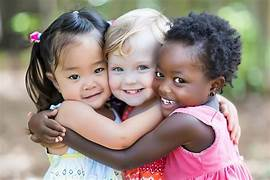
Australia is a vibrant, multicultural society characterized by a rich tapestry of cultural backgrounds, languages and family configurations. In the field of early childhood, social context refers to the diverse environments in which children are raised and the social networks that support them.
According to 2021 Census data, more than 27% of the Australian's population was born overseas and almost half of Australians have parents born abroad. This cultural diversity means that early childhood centers are "microcosms" of the global community. Furthermore, the definition of "family" has evolved beyond the nuclear model to include single-parent households, multi-generational families, kinship care, and LGBTQI families.
Theoretical Basis:
• Vygotsky’s Socio-Cultural Theory: Vygotsky emphasizes that social interaction and cultural tools are fundamental to cognitive development. Learning is a social process where children acquire knowledge through interactions with "More Knowledgeable Others" (MKOs) within their specific social context.
• Funds of Knowledge (Moll et al., 1992): This theory suggests that every family has a wealth of cultural and cognitive resources. Educators should recognize and integrate these "funds" into the curriculum to make learning relevant and inclusive.
Impact on Children and Families
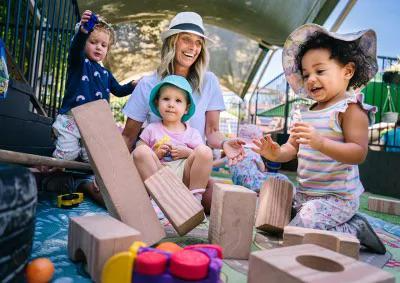
Identity and Belonging: A child's sense of self is deeply tied to their social and cultural background. Research from the Victorian Curriculum and Assessment Authority (VCAA) emphasizes that when a child's home culture and language are reflected in the learning environment.
When their family culture is reflected at the center, it fosters a strong sense of belonging, which is a prerequisite for effective learning (VCAA, 2020)
Language Development: Many children in Australian centers are EAL/D (English as an Additional Language or Dialect). Maintaining the "home language" is important for developing cultural awareness and connection. According to ACEQA (2023), maintaining a child's first language provides a strong foundation for learning English and supports overall neural plasticity.
Social Inclusion vs. Exclusion: Families from marginalized social groups or those with non-traditional structures may experience social isolation if the educational environment is not explicitly inclusive.The Early Years Learning Framework (EYLF V2.0) mandates that educators act as advocates for social justice to prevent the exclusion of children based on their family’s social or cultural background.
Social Policy and Community Engagement: A Commitment to Inclusion
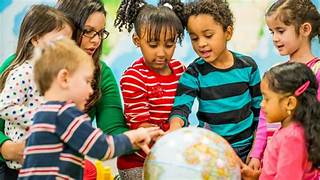
In Australia, social policy in early childhood is not just about guidelines; it is a dedicated commitment to reconciliation and social justice. This is primarily governed by two major frameworks that ensure every child, regardless of their social background, receives equitable support.
A. The Early Years Learning Framework (EYLF V2.0): Cultural Safety and First Nations Perspectives
The 2022 update to the EYLF (V2.0) has elevated the importance of Cultural Safety. This goes beyond merely acknowledging different cultures; it requires educators to create an environment where Aboriginal and Torres Strait Islander histories, cultures, and languages are valued and integrated into the daily curriculum.
Core Responsibility
Educators are now mandated to engage in “Continuous Professional Learning” related to Indigenous perspectives. This is not an option but a core professional standard to promote a reconciled Australia.


Cultural Safety in Practice
It involves critically reflecting on one's own biases and ensuring that the center is a place where First Nations families feel their identities are respected and their voices are heard.

B. National Quality Standard (NQS) - Quality Area 6: Collabrative Partnerships
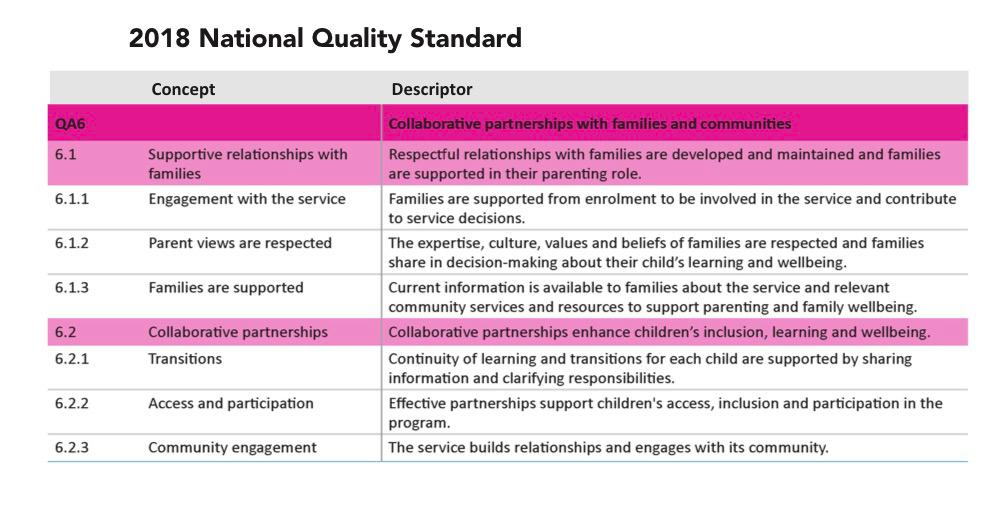
Quality Area 6 of the NQS emphasizes that "partnerships with families and communities" are essential for achieving the best outcomes for children. A child does not exist in a vacuum; they belong to a broader social network.
Collaborative Partnerships
This policy encourages centers to move beyond simple communication and toward true collaboration. This means families are involved in decision making and curriculum planning.
Community Engagement
This policy encourages centers to move beyond simple communication and toward true collaboration. This means families are involved in decision making and curriculum planning.
C. Strategic Implementation
To fulfill these policy requirements and ensure high-quality social support, our center implements the following evidence-based strategies:
Reconcilitation Action Plan (RAP)
We actively develop and implement a RAP through the Narragunnawali platform to demonstrate our formal commitment to Aboriginal and Torres Strait Islander peoples. This process ensures that reconciliation is embedded in our curriculum and professional practice rather than being a mere tokenistic gesture (Reconciliation Australia, 2024).


Multicultural Liaison
We assign staff member or community volunteers as cultural liaisons to bridge the communication gap between the center and families from diverse linguistic backgrounds. This practice is consistent with ACEQA's recommendations to promote "cultural competency" and ensure that every family's voice is heard in the decision-making process (ACECQA, 2023).
Community Resource Mapping
We maintain an updated directory of local social services, such as child health nurses, family support workers and playgroups, to provide immediate referrals to families in need. Research by Siraj-Blatchford and Siraj (2023) highlights that “wrap-around” community supports are essential to improve long-term outcomes for children in diverse social contexts.
Inclusive Enrollment Policies
We ensure our enrollment process is accessible by providing translated documents and one-on-one support for families who may find administrative systems overwhelming. According to the Department of Education (2022), reducing administrative barriers is a key step toward achieving the principle of Equity as outlined in the EYLF V2.0.
Professional Reflection: The Educators as a Cultural Weaver
In my professional practice, I view each child's social and cultural background not as a challenge to be managed, but as a 'Fund of Knowledge' that enriches our entire learning community. Reflecting on the 2021 Census data and the tasks of EYLF V2.0, I realize that my role extends beyond the classroom walls. I am a 'cultural weaver' - someone who bridges the gap between a child's home life and their educational journey.
When I implement a Reconciliation Action Plan or facilitate a Multicultural Liaison, I am actively dismantling the barriers to social exclusion. My goal is to ensure that every child - whether they come from a multi-generational Australian family, a newly arrived migrant household or a kinship care arrangement - feels a deep sense of belonging. True inclusion means that a child's identity is not only 'accepted' but is celebrated as a foundational part of our curriculum
Create Your Own Website With Webador